Not every man gets to have a dinosaur named after him. But Lin Ottinger was no ordinary man. Known as Moab’s “Dinosaur Man,” Ottinger built a life from the red rock and prehistoric bones of southeastern Utah, leaving behind a legacy that blends science, storytelling, and adventure. His contributions to paleontology, tourism, and the local community are as deeply embedded in Moab’s landscape as the fossils he spent decades uncovering.
Born in 1927 in Wyoming, Ottinger’s fascination with the natural world started early. As a child growing up in Tennessee, he collected arrowheads and rocks, selling them to a local barber for extra money. That passion never left him. In 1960, a trip west led him to Moab, a place whose raw beauty and geological wonders captured his imagination. What began as a brief visit turned into a lifelong love affair with the land.
Ottinger set up the Moab Rock Shop in 1960, a modest yet mesmerizing storefront brimming with fossils, minerals, and curiosities. The shop quickly became a must-visit stop for geologists, rockhounds, and tourists eager to take home a piece of Utah’s prehistoric past. But Ottinger wasn’t just a shopkeeper, he was an explorer. His excursions into the desert led to major paleontological discoveries, including the remains of an Iguanodon species that would later be named Iguanodon Ottingeri in his honor — the first of its kind identified in North America.
Utah Stories had the pleasure of interviewing Ottinger several times, and even had the opportunity to join him on a journey to the White Rim, where he shared his deep knowledge of Moab’s backcountry and its ancient secrets. Recalling his early days, Ottinger once said, “I let the rocks tell me their story.”
Beyond dinosaurs, Ottinger’s explorations led to one of Moab’s most debated archaeological finds. In 1971, he and his 11-year-old son discovered two human skeletons in a copper mine, their bones stained green from nearby minerals. Dubbed the “Moab Man,” the find sparked controversy, with some creationists claiming the remains were millions of years old, proving humans coexisted with dinosaurs. Scientists later dated them to between 1700 and 1840 CE, but Ottinger believed uranium deposits had skewed the results, keeping the mystery alive. He remarked, “These people make it all up, that it was 2 million years ago, that it was 100 million years ago. But I know the truth — I spent time out there studying it.”

His deep knowledge of the land made him an invaluable guide for visitors, including Hollywood filmmakers scouting Moab’s iconic landscapes. He led backcountry tours for more than 30 years, taking guests into the rugged beauty of the White Rim, where he shared not just fossils and rock formations but also his own experiences, blending science with the kind of frontier storytelling that made every journey unforgettable.
Even as Moab transformed from a quiet mining town into a thriving outdoor recreation hub, Ottinger’s rock shop remained a constant, run by his son since 2005. To this day, it stands as both a museum and a tribute to the man who spent his life unearthing the past.
Lin Ottinger passed away at 97, leaving behind more than just fossils and bones. He left a legacy of curiosity, adventure, and a profound connection to the land. Lin is survived by 2 daughters, Raine Guymon and Nina Edgington, and a son, Lindy Ottinger, Jr. (Sonny), seven grandchildren and seven great-grandchildren.
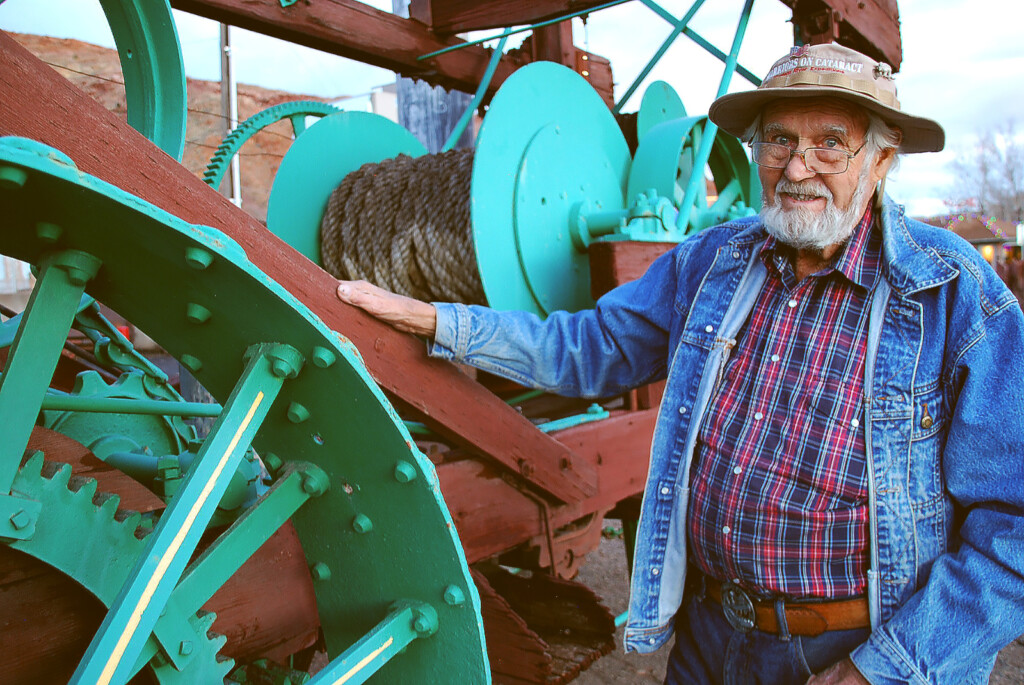
Feature Image of Lin Ottinger by Richard Markosian.